Designing an AI copilot for navigating opportunities and mapping student skill gaps
- Disciplines
- AI Product · UX Strategy · Prototyping
- Platform
- Exclusive student platform
At a quick glance
- 2.71 Sessions per user (retention)
- 78% Role matching trust
- 4.79 User rating
- 4.5min Average session
Students arrive at their university careers appointments unsure of their own skills, and unaware of the paths open to them.
Most students can name a few of their current strengths, but not the wider skill set their degree is building, and they rarely spot the ones they already have. Even those who feel sure of their strengths hit a wall, unable to connect them to real career paths or see where their gaps actually are.
Career Inspiration is the AI career copilot I led the design on to change that. It maps a student’s skills against real roles, surfaces paths they’d never considered, and gives them transparent, data driven insight into their strengths and gaps, so they walk into that appointment with real direction.
As UI/UX Lead I owned the product vision and the AI interaction strategy. My core challenge was turning our own dataset of over 130,000 graduate jobs into a discovery product that could serve thousands of students during the high stakes enrolment window.
The product runs on a B2B2C model, white labelled so an institution can engage its entire first year cohort at the point of entry. To make that scale, I shaped a chat first interface and guided journeys that map a student’s skills to real career pathways.
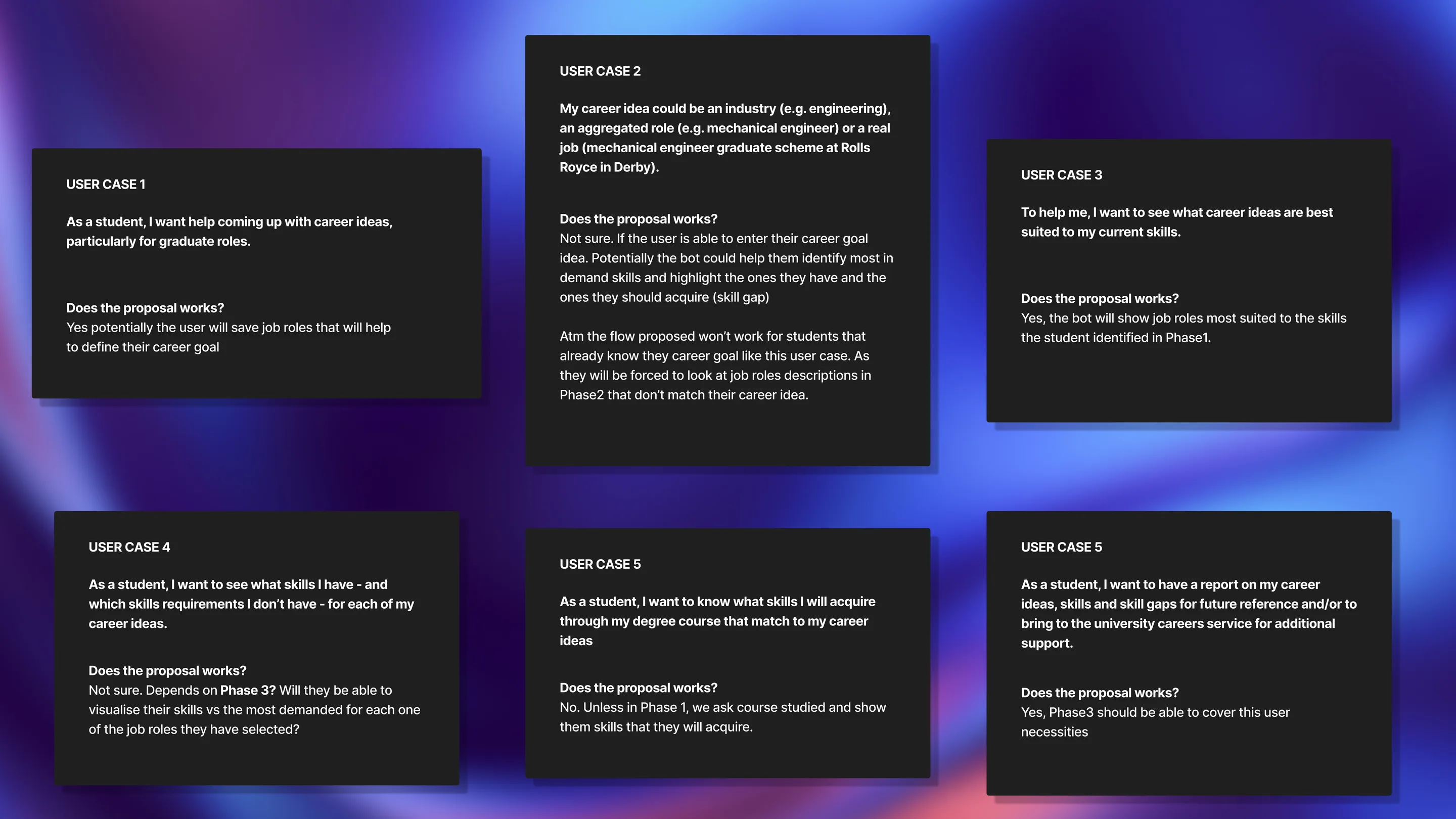
High fidelity testing forced us to rethink our approach. The gesture led, gamified experience we’d initially proposed for Gen Z turned out to be the wrong approach.
We created quick prototypes of a few key screens to test a playful, social media style UI with our Gen Z users. The verdict was clear, what works for TikTok and Deliveroo doesn’t work for high stakes career planning. Students viewed the expressive UI as a novelty, which eroded the platform’s credibility. They made it clear that for their professional futures, they demand clean, simplified, and high utility design. Taking this insight, I immediately pivoted our strategy dropping the gamified swiping mechanics in favour of clear, structured user journeys that respected the gravity of their career decisions.
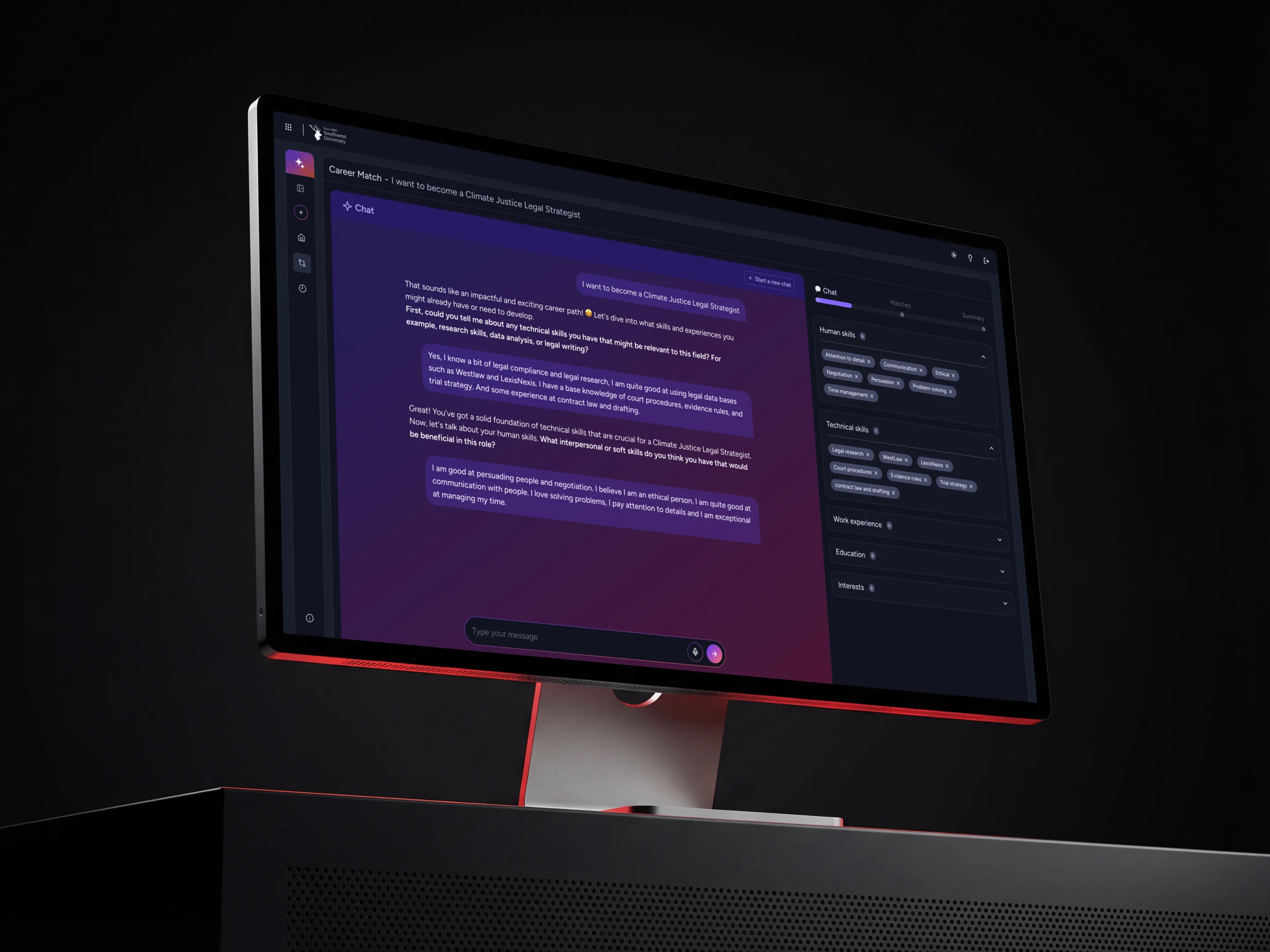
I established a foundational interaction pattern for the product The Command Centre
The Command Centre provides instant feedback, letting users see their information being extracted in real time.
To solve the black box problem of AI, I established a foundational interaction pattern for the product, the Command Centre. The architecture relies on a dual pane interface designed for visual feedback. A central chat extracts user intent while a fixed sidebar visualises their interactions in real time.
By keeping a human in the loop we created a highly predictable mental model. Students can instantly verify, tweak and edit the LLM’s learnings live, turning what is usually a mysterious, unpredictable process into a transparent, high trust interaction that is actually useful.
The chat and the Command Centre stay in sync, so input in one is reflected in the other. If a student disagrees with an extracted skill they can dismiss it from the Command Centre, and the chat responds conversationally to acknowledge the change. A request made in the chat updates the Command Centre directly too, so the student never has to repeat themselves or switch context to correct the system.
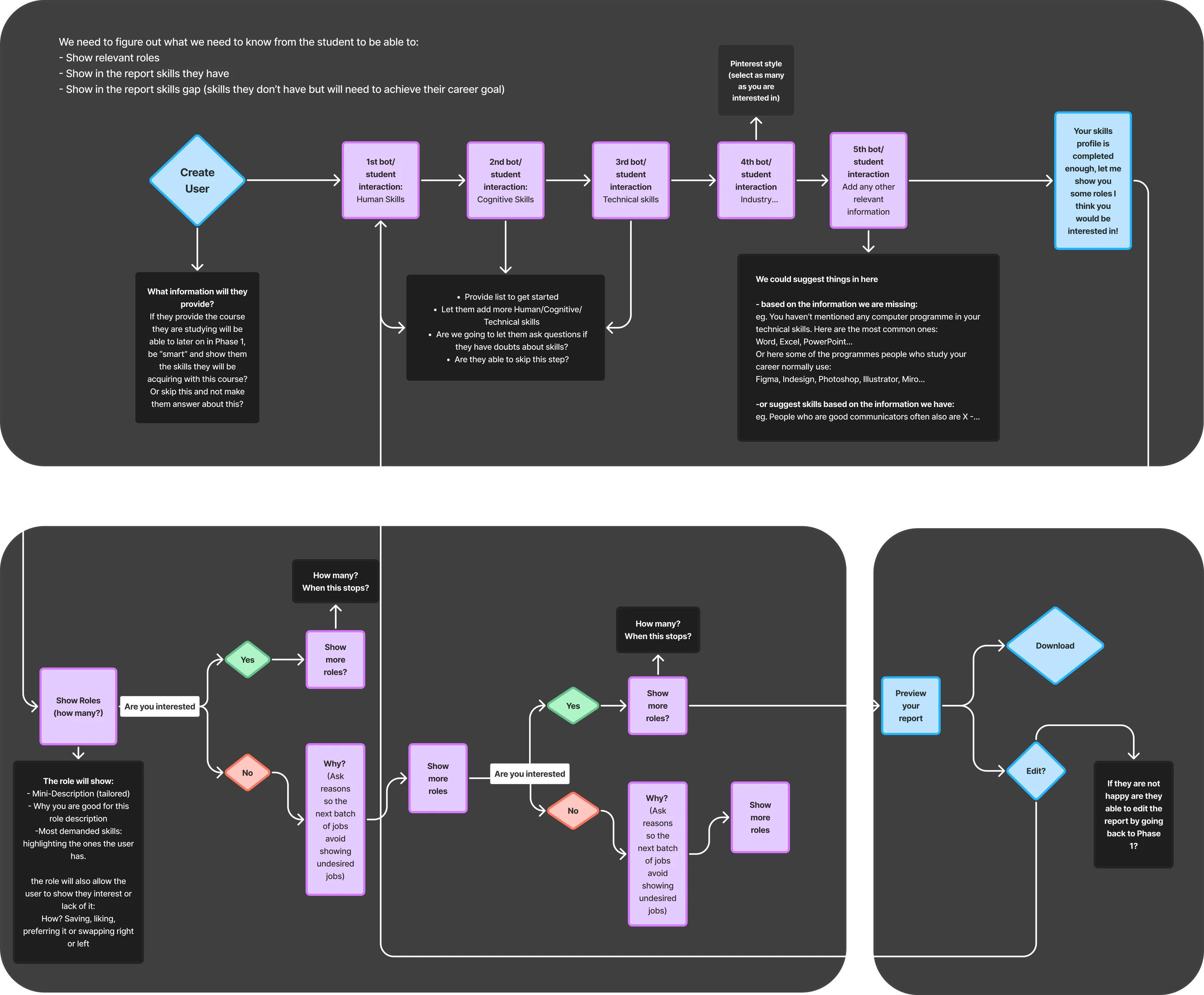
Onboarding, chat, skills and matches
I opened the journey with a chat first phase, designed to bypass the friction and fatigue typical of standard AI onboarding.
Standard AI onboarding starts cold, an empty chat that quizzes you for the basics. I designed ours to feel like it already knew the student. By pre-filling the onboarding state with data we already held, like course enrolment and sector interests, the first screen lands personal rather than blank.
Knowing a student’s course let the product infer the skills they hold now and the ones they’ll gain by graduation, so the chat could skip the admin. I kept it focused on the one thing only the student can give, their intent and nuance, while relevant matches were ready from the first message.
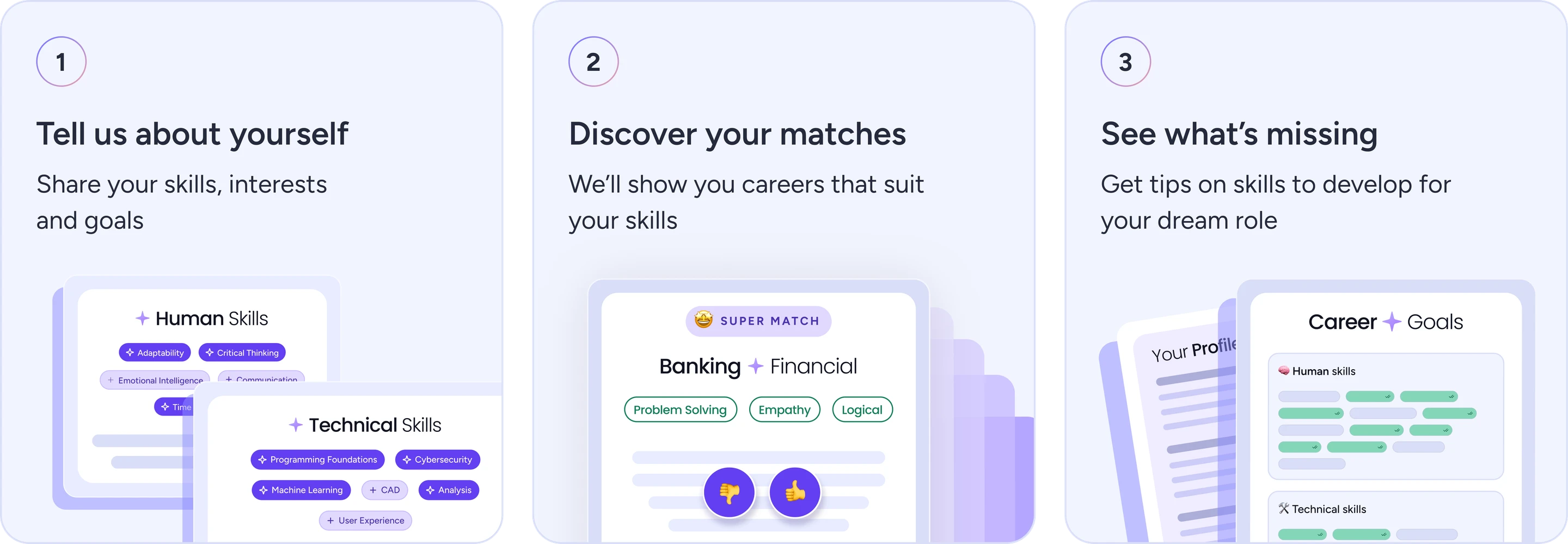
I pivoted the data model from individual job listings to a curated set of career pathways.
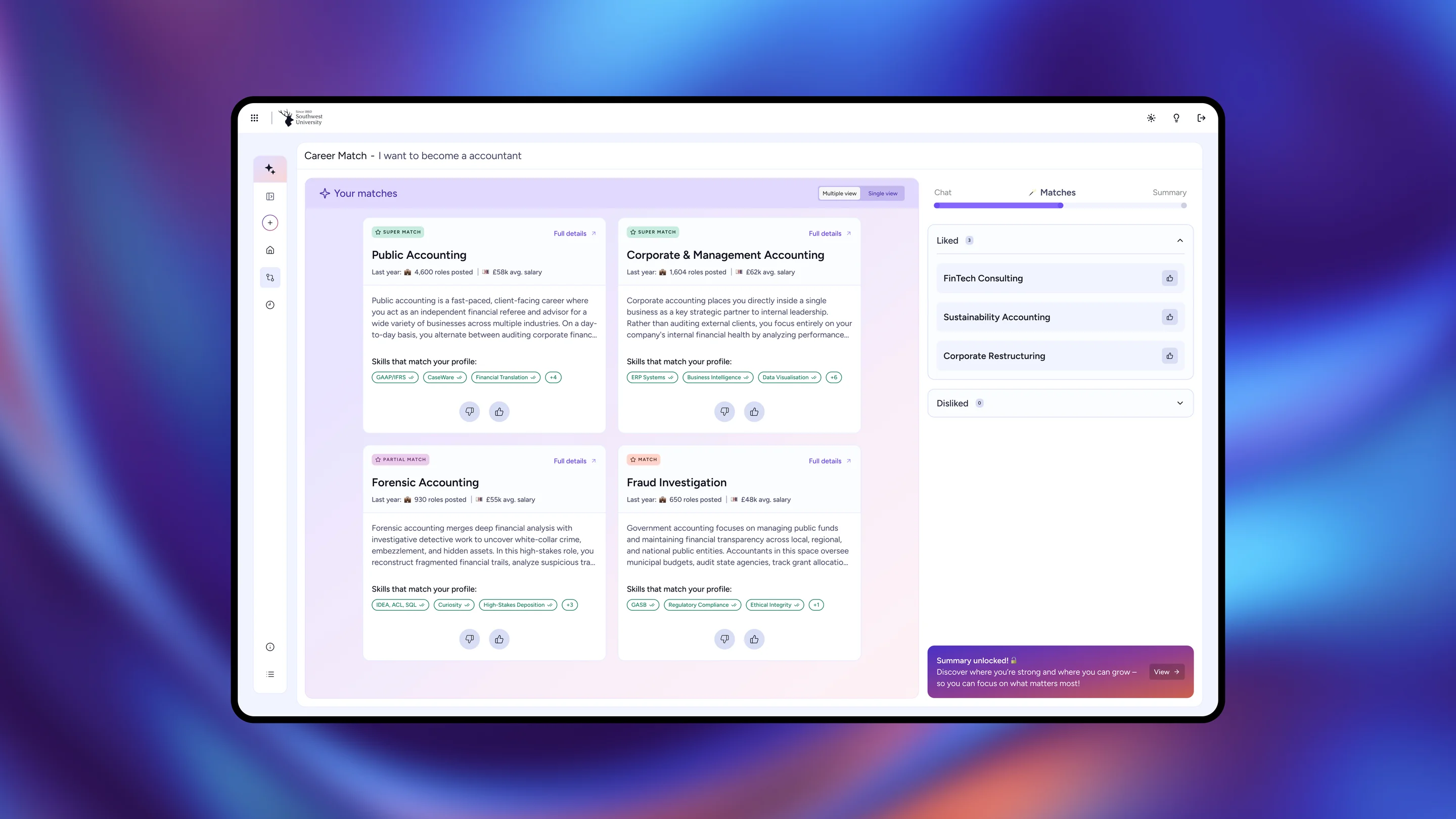
Initially we matched students directly to scraped job listings, but user testing revealed this was overwhelming and cluttered with duplicate roles. So I pivoted the data model from raw listings to a curated set of career pathways. Matching students to high level pathways first focused the experience on long term career discovery, with clean data on salary ranges, typical roles and historical placements, and only surfaced live, active roles once a student chose to explore deeper.
Designing encouraging match states.
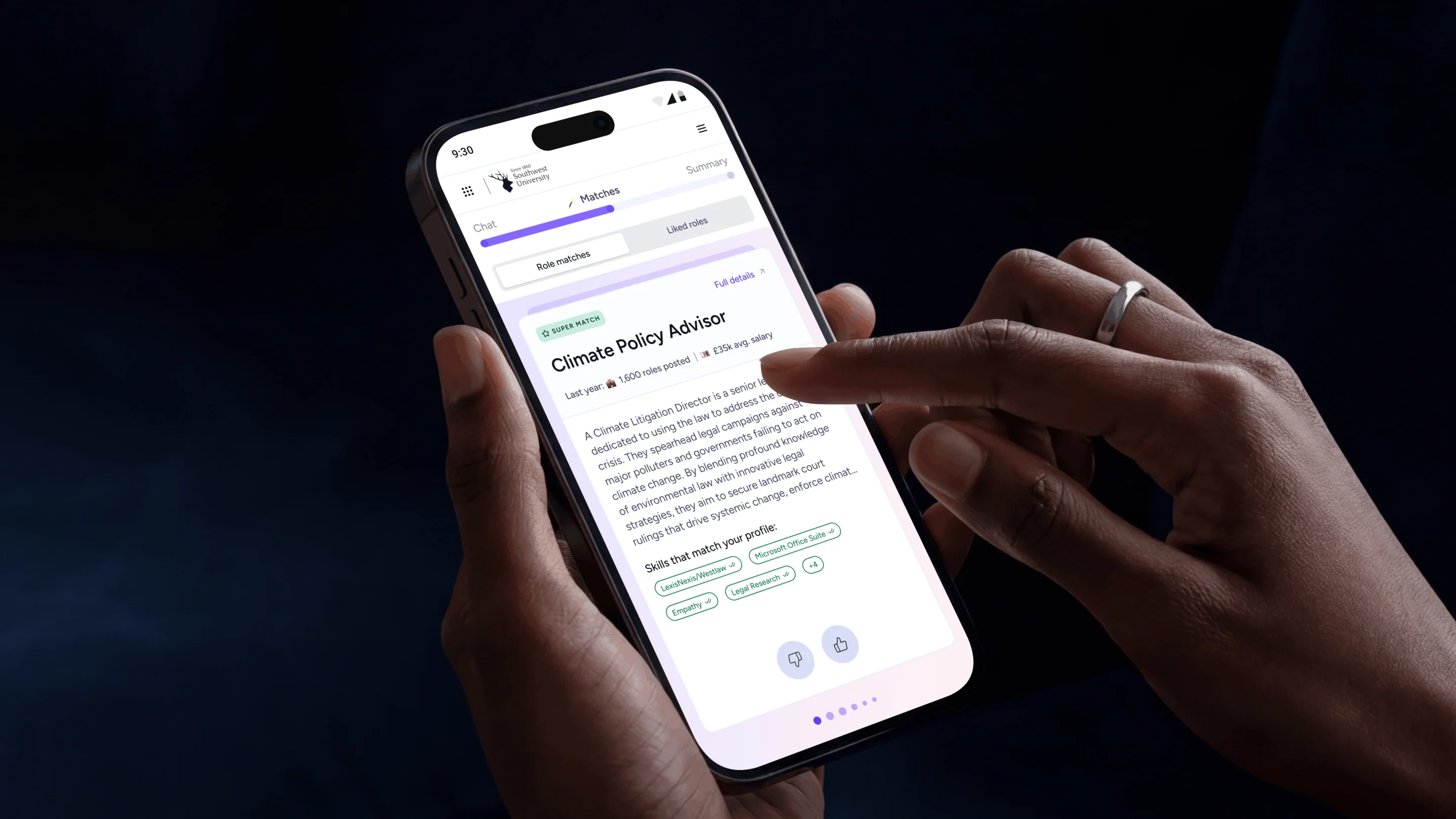
I designed the psychology of the matching classifications. To keep students inspired I rejected discouraging labels like ‘weak match’ and clinical percentages, opting instead for a supportive hierarchy of Super Match, Match and Partial Match. Rather than signalling a dead end, a Partial Match serves as an encouraging transition. In the final profile summary I pair it with specific skills to develop, transforming a student’s skill gaps into a clear, actionable roadmap for future growth.
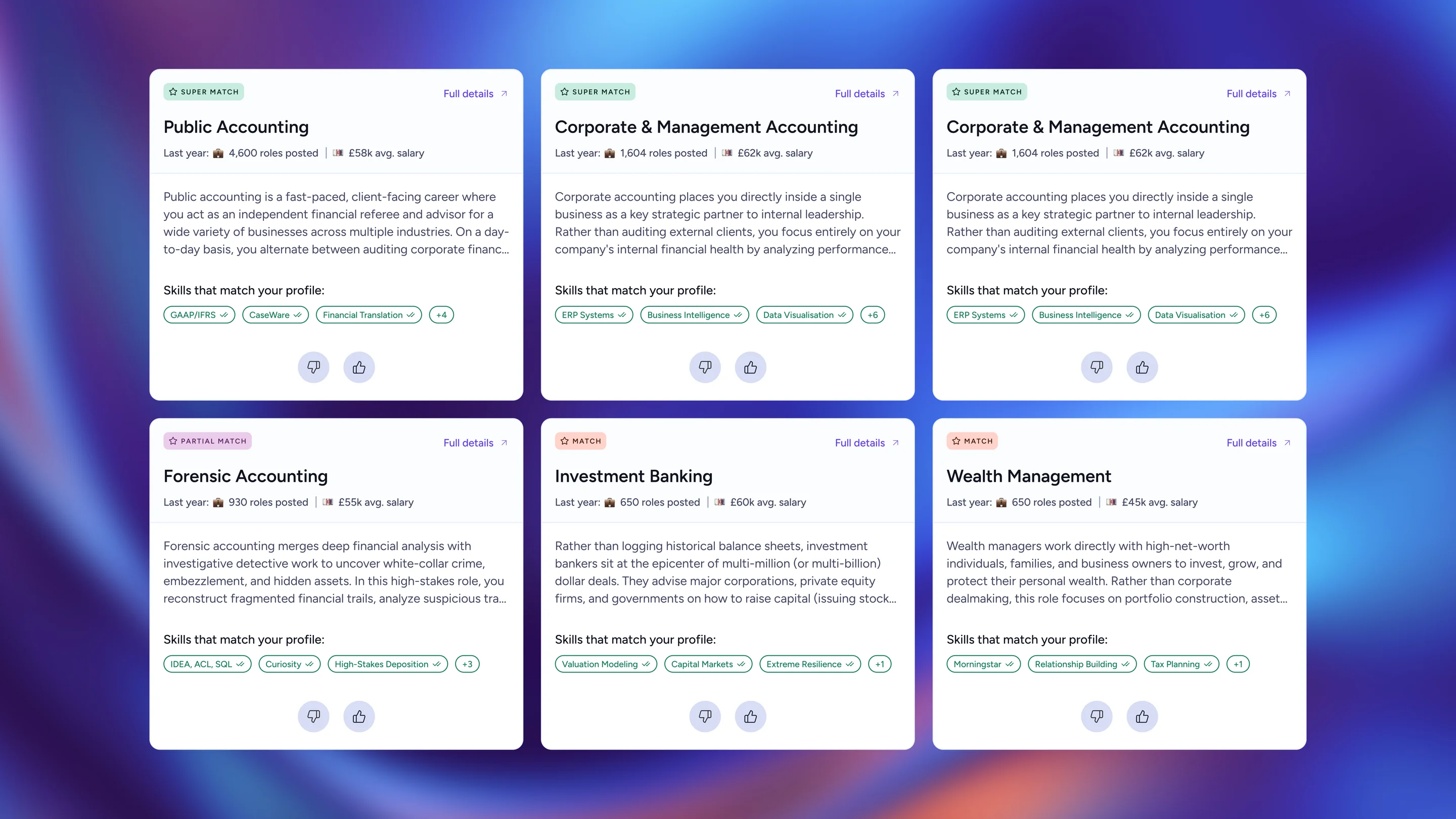
We designed the platform to directly answer the primary challenges university career services face when guiding students.
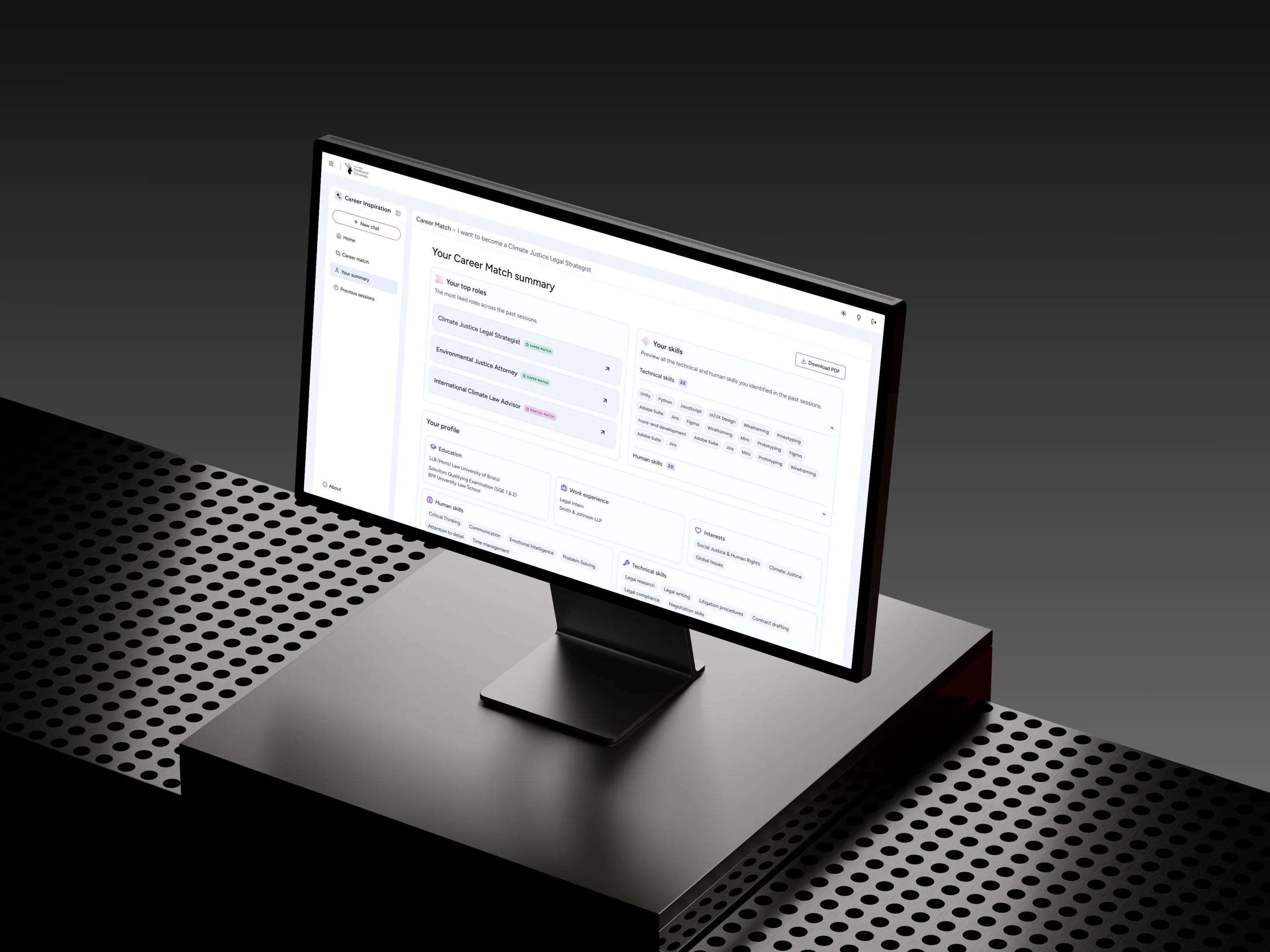
Students often arrive at advising appointments with no direction and little self awareness of their capabilities, so the tool does the student’s groundwork before the appointment. By mapping a student’s existing skills against real world industry requirements, the interface immediately identifies their Super Matches and visualises their specific skill gaps, giving both the student and the advisor an instant, data driven starting point.
This shifted the advisor’s role from basic discovery to high value coaching. Students arrive with a validated vocabulary of their own skills, and the summary report was designed to be advisor ready from day one.
Capturing real time student interaction
Beyond the immediate value delivered to students, the platform generated an incredibly powerful byproduct.
A reporting engine for universities, built from every student interaction. By tracking precisely what students ask the AI and how they rate their own skills, we unlocked a level of big picture insight institutions previously had no way of accessing.
For the first time, universities can identify skill gaps across their entire student body, pinpointing skills a whole year group might be missing. It turns what used to be a feedback black hole into a strategic goldmine, exactly the data needed to tailor workshops, adjust curriculum focus and proactively address the shifting needs of their students.
In the MVP, students rated Career Inspiration 4.79 out of 5 and completed the chat with no onboarding drop off, and universities now use it to engage their entire first year cohort.